
Strings and indices
What you'll learn:
- take a character of a string by its number—from the start and from the end;
- cut a piece out of a string with bounds and a step;
- explain why a string cannot be changed, and get new strings with methods;
- build text out of values with f-strings.
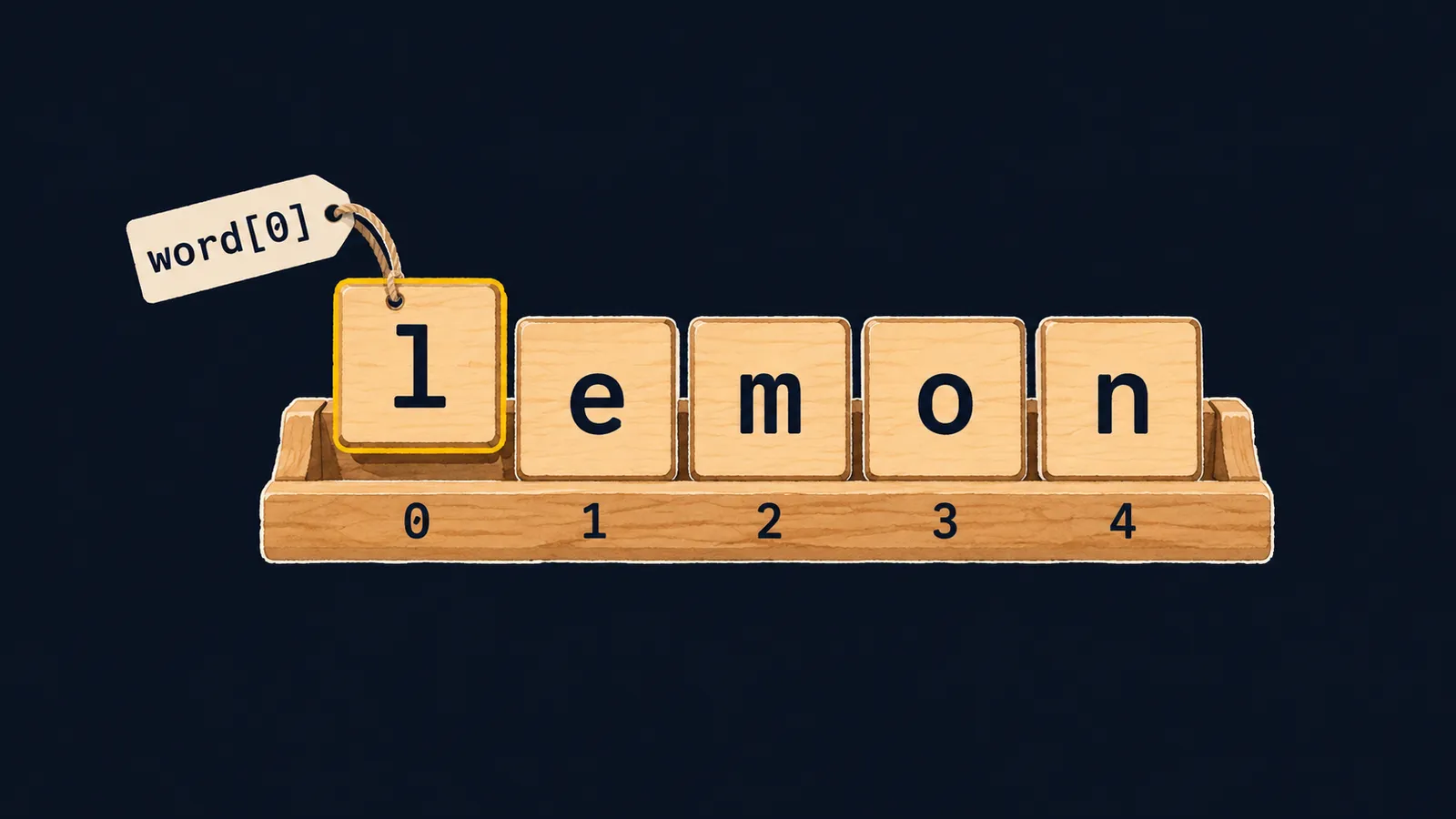
Picture a rack of tiles from a word game. Five tiles with the letters l, e, m, o, n stand on it, spelling the word lemon. Under each tile is its number: 0, 1, 2, 3, 4.
To take the first tile, you call out its number, and the tile rises above the rack. The lifted tile carries a tag, word[0]: that is what Python calls this tile.
A string in Python works the same way. It stores characters in order, like tiles on a rack, and each character has a number. A program often needs one character: the first letter of a name, the last digit of an order code. The number of the character you need goes in square brackets after the string:
word = "lemon"
print(len(word))  # 5
print(word[0], word[1], word[4])  # l e n
print(word[-1], word[-5])  # n l
print("mon" in word, "Mon" in word)  # True False
Let's go through the example line by line:
word = "lemon"binds the namewordto a string of five characters.len(word)counts the tiles on the rack: there are5.word[0],word[1]andword[4]are the first, second and last letters:l e n.word[-1]andword[-5]count from the right edge: the last letternand the first,l."mon" in wordchecks whether the tilesm,o,nstand on the rack in a row, and"Mon" in wordlooks for a capitalM.
Index
The number of a character in a string is called its index. Counting starts at zero: word[0] is the first character, word[1] is the second.
People count things from one, so this feels odd at first. This rule helps: the index tells how many tiles stand to the left. No tile stands left of the first one, so its index is 0.
The len function returns the length of a string—the number of characters in it. So the last index is one less than the length: in the five-character string "lemon" it is 4.
What else to know about an index:
word[0]returns a string of one character, of typestr: you can print it, compare it or join it with another string;- a space is a character too, and
len("a b")is3; - the empty string
""has length0and no indices at all.
A string is a sequence: its values stand in order, and each one can be reached by its index. The loop for ch in word goes through the characters in the same order, from index 0 to the last one.
Here the rack analogy ends with one caveat. A tile on a rack can be swapped for another, but a character in a string cannot. A string can be read by index, but not rewritten.
Negative indices
You often need a character from the end: the last digit of a number, the last letter of a word. Counting the length every time is inconvenient, so characters have a second numbering—from right to left.
A negative index counts characters from the end: word[-1] is the last character, word[-2] is the one before it. Python replaces a negative index i with len(word) + i. So word[-1] is the same as word[len(word) - 1]. The leftmost negative index is -len(word): in a five-letter word, word[-5] is the first letter, l.
This is how you take the last character without counting the length:
code = "A-1047"
print(code[-1], code[-4])  # 7 1
print(code[len(code) - 1])  # 7
Let's go through it line by line:
code[-1]is the last character,7, andcode[-4]is the fourth from the end,1.code[len(code) - 1]gives the same7, but it is longer and easier to get wrong.
Interviewers like to ask this: "What do s[-1] and s[-len(s)] return?" The answer is the last and the first characters of the string.
The in operator
The expression a in s checks whether the string a occurs inside s as a whole: character after character, in a row. The result is True or False.
The in operator checks a single character and a whole word alike:
"e" in wordand"mon" in wordare bothTrue;"mn" in wordisFalse: both letters are there, but not in a row;"Mon" in wordisFalsetoo: letter case matters;"x" not in wordisTrue:not ingives the opposite answer.
Common mistake
The last character is taken by an index equal to the length:
word = "lemon"
print(word[len(word)]) # ✗IndexError: string index out of rangeThe indices of a five-character string run from 0 to 4, and it has no index 5. Python stops the program with an IndexError. A negative index left of the first character, such as word[-6], gives the same error. The last character is word[len(word) - 1], or shorter, word[-1].
Key points
- An index is the number of a character in a string; counting starts at zero, and the last index is
len(s) - 1. - A negative index counts from the end:
s[-1]is the last character,s[-len(s)]the first. - An index outside the string raises an
IndexError. a in schecks whetherastands insidesin a row, and case matters.
Subscribe to take the course
The course is free. Sign in with Telegram and subscribe to the channel to open every lesson.


