
Modules and import
What you'll learn:
- load standard library modules with the three forms of
import; - tell running a file from importing it with
__name__; - save data to a file and to the JSON format, then read it back;
- get values one at a time through iterators and generators.
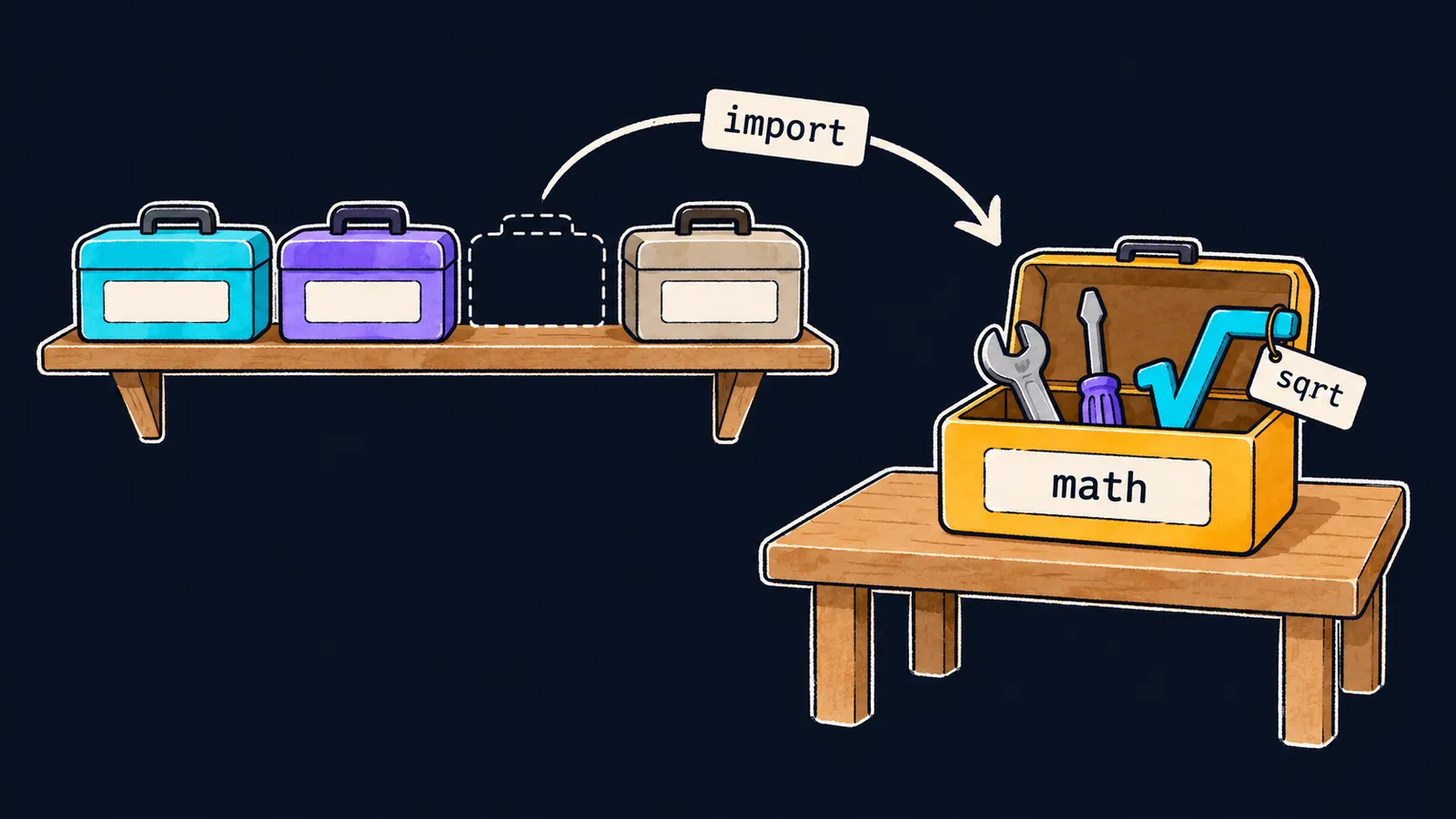
Picture a workshop. The tools you need every day lie on the workbench. Everything else is sorted into boxes on the shelves, and each box is labeled with what it holds. When you need a rare tool, you take the right box off the shelf and put it on the bench.
Python works the same way. The functions print, len and sorted lie on the bench: they are available in any program right away. Square roots, random numbers and reading JSON sit in boxes on the shelf. Such a box is called a module — a .py file with ready-made functions.
You put a box on the bench with the import statement:
import math

print(math.sqrt(16))  # 4.0
print(math.floor(2.7), math.pi > 3)  # 2 True
Let's go through the example line by line:
import mathputs the boxmathon the bench: the program gets the namemath.math.sqrt(16)takes the functionsqrtout of the box and computes the square root of16.math.floor(2.7)rounds down and gives2, andmath.piis the number π from the same box.
The dot between the names reads as "from the box math, take sqrt". The modules math, random, collections and json belong to the standard library — they are installed together with Python, and you do not need to download them.
Three forms of import
You can put the whole box on the bench, or take only the tools you need out of it. Let's go through the three forms one by one.
import module
The line import math gives one name — math. Every call is written through the dot: math.sqrt, math.floor. This is the most common form: the call math.sqrt shows at once where the function came from.
from module import name
The from … import form, familiar from data classes, takes single names out of a module. You write them without the module name. After from math import sqrt, the program has only sqrt, and no name math. This is handy for names that appear often in the program.
import module as another name
The word as gives a module or a function another name. Usually it shortens a long module name. All three forms in one program:
from math import sqrt, floor
import statistics as st

print(sqrt(25), floor(-2.5))  # 5.0 -3
print(st.mean([2, 4, 9]))  # 5
floor rounds down, toward the smaller integer, so -2.5 becomes -3. The mean function of statistics computes the average: the sum 15 divided by 3 items is 5. The line from random import choice gives the function choice the same way; it returns a random element of a list.
Interviewers like to ask this: "How does import math differ from from math import sqrt?" The answer: the first form creates the module's name, the second only the function's name.
How a module runs
Your own module is any .py file. Say greet.py with a function hello sits next to the program. The program loads it with the line import greet and calls greet.hello(). A module's name is its file name without .py.
The interpreter looks for a module first in the folder of the running program, then in the standard library. On the first import, it runs the module's file from top to bottom and creates a module object.
Here the box analogy stops working. You can bring a real box twice and end up with two boxes. A repeated import does not read the file again and returns the same object: after import math and import math as m, the expression m is math gives True. So a print outside any function in greet.py fires once, no matter how many times the module is imported.
Modules are grouped into packages. A package is a folder with modules and an __init__.py file, which may be empty. A module from a package is loaded through a dot:
import shop.cartruns the fileshop/cart.py, and calls are written throughshop.cart;from shop import cartgives the short namecart.
Common mistake
The whole module was imported, but the function is called without its name:
import math

print(sqrt(16)) # ✗NameError: name 'sqrt' is not definedimport math creates only the name math, and sqrt stays inside the box. Write math.sqrt(16) or import the function with the line from math import sqrt.
Key points
- A module is a
.pyfile with ready-made functions, loaded with theimportstatement. import mathgives the namemath,from math import sqrtgives onlysqrt, andasgives another name.- A module's file runs on the first
import; a repeated one returns the same object. - A package is a folder with modules and an
__init__.pyfile.
Subscribe to take the course
The course is free. Sign in with Telegram and subscribe to the channel to open every lesson.


