
Classes
What you'll learn:
- describe objects of one kind with a class and create them with
new; - compute a property with a getter, hide data in a private
#field and create objects with a static method; - build a subclass with
extendsand call the parent throughsuper; - explain where methods live and how JavaScript finds them along the prototype chain.
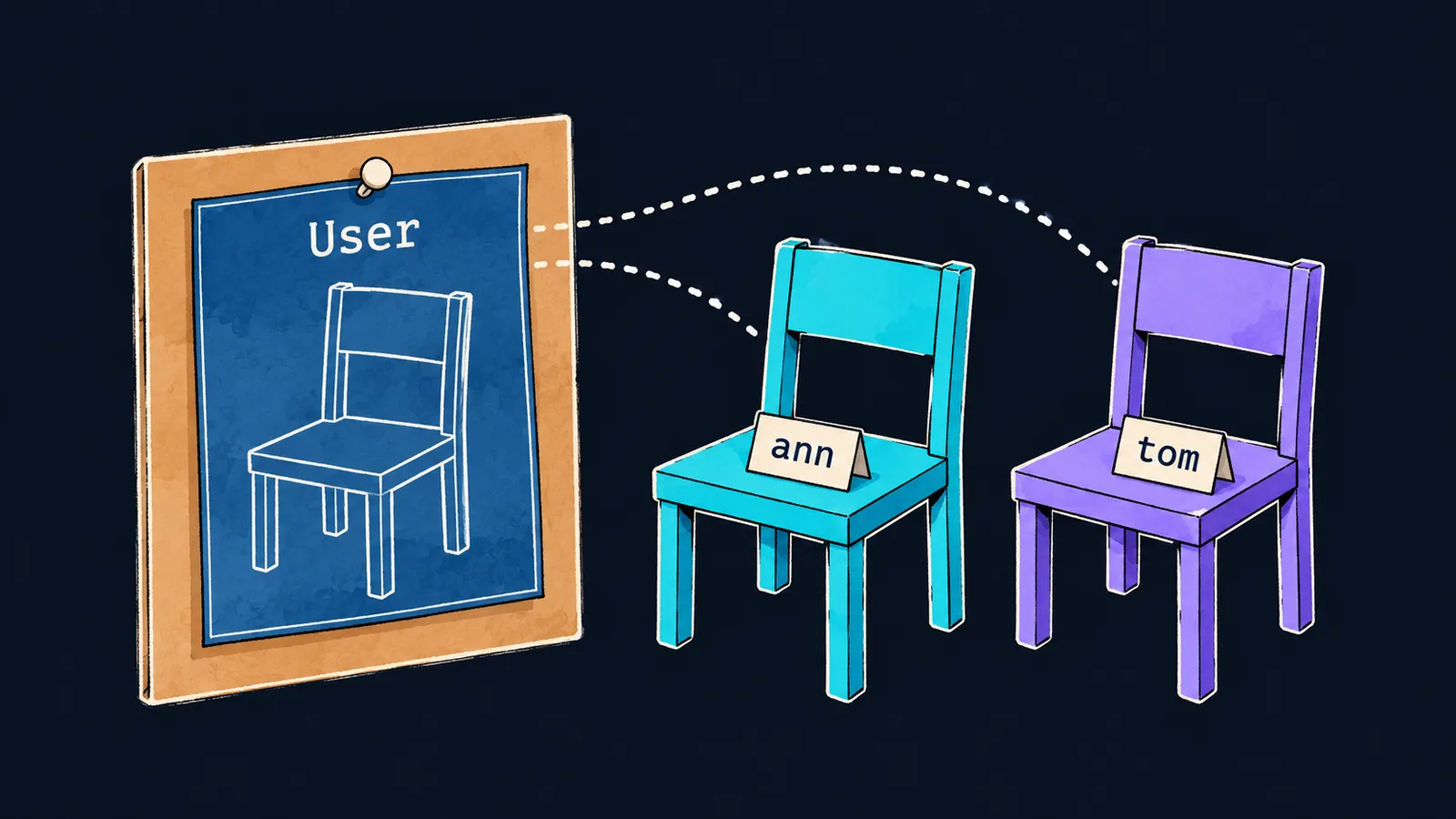
Picture a furniture factory. An engineer draws the blueprint of a chair once: its legs, seat and back, and how to put it together. From this blueprint the workshop builds hundreds of chairs. Each one has its own color, but they are all made the same way.
A program works the same way: there are many users, products or orders, and they all have the same properties and actions. A function that builds an object from its parameters describes the object anew on every call: each property and each method. When there are many similar objects, it is handier to describe their common shape once, with a class. The class is the blueprint, and the objects are the chairs built from it:
class User {
    constructor(name, age) {
        this.name = name;
        this.age = age;
    }

    isAdult() {
        return this.age >= 18;
    }
}

const ann = new User("Ann", 30);
const tom = new User("Tom", 12);
console.log(ann.name, ann.isAdult()); // Ann true
console.log(tom.name, tom.isAdult()); // Tom false
Let's walk through the example:
class User { … }is the blueprint: every user will have the propertiesnameandageand the methodisAdult.new User("Ann", 30)builds the first object from the blueprint, andnew User("Tom", 12)builds the second.- The first
console.logprintsAnn true: the age ofannis 30, which is at least 18. - The second prints
Tom false: the same method answers differently fortom, who is 12.
Class and instance
A class describes objects of one kind: which properties and methods they have. An object created from a class is called an instance: ann and tom are two instances of the class User. By convention, a class name starts with a capital letter.
A class body looks like an object literal, but it has its own rules:
- methods are written without the word
function; - there are no commas between methods;
- the method named
constructorfills in each new object.
What new does
The new operator creates an instance. Let's take the expression new User("Ann", 30) step by step:
newcreates a new empty object.- Then it calls the
constructormethod with the arguments"Ann"and30. - Inside
constructor, the wordthismeans this new object, sothis.name = namewrites the propertynameinto it, andthis.age = agewrites the propertyage. newreturns the finished object, and it lands in the constantann.
Under the hood, a class is a special function: typeof User gives "function". But it can be called only through new: the common mistake at the end of the lesson shows what happens without it.
Methods shared by all
The isAdult method is shared by all instances: it is not copied into each object. In the call tom.isAdult(), this is tom, as with any method called through a dot. That is why each instance answers about its own age.
Here the factory analogy stops working. A finished chair lives on its own and no longer needs the blueprint. An instance, though, keeps using the class's methods: they live in one place, and every instance reaches for them there.
Fields
A property can be declared right in the class body, outside constructor: count = 0;. Such a property is called a field. Each instance gets its own field with the starting value, even before the body of constructor runs. If there are no other properties, constructor can be left out entirely.
class Counter {
    count = 0;

    increment() {
        this.count++;
        return this.count;
    }
}

const a = new Counter();
const b = new Counter();
a.increment();
console.log(a.increment(), b.count); // 2 0
Let's see what happens to the counters:
- Both calls
new Counter()create objects with their own fieldcount, equal to0. - The first call
a.increment()raisesa.countto1. - The second call, inside
console.log, raises it to2and returns2. b.countis still0: a method changes the field of the object it was called on.
Strict mode in a class
A class body always runs in strict mode, even without the line "use strict". If a method assigns a value to a misspelled variable name, the program stops with a ReferenceError, and no global variable appears. That way you see the typo at once, not after an hour of searching.
Common mistake
A class was called without new, like an ordinary function:
const bob = User("Bob", 20); // ✗TypeError: Class constructor User cannot be invoked without 'new'This is the Node.js and Chrome message. An ordinary function would run without new too, but a class forbids such a call and stops the program at once. An instance is created only through new: new User("Bob", 20).
Key points
- A class describes objects of one kind once, and
newbuilds instances from it. newcreates an empty object, callsconstructorwiththisset to that object, and returns the object.- Class methods are shared by all instances, while each instance has its own fields.
- A class is called only through
new, and its body always runs in strict mode.
Subscribe to take the course
The course is free. Sign in with Telegram and subscribe to the channel to open every lesson.


