
A stack on a slice
What you'll learn:
- build a stack on a slice: push a value onto the top and pop it off;
- check nested brackets with a stack;
- merge two sorted slices with the two pointers technique;
- put together a small type from a
map, methods and errors—the course's final project.
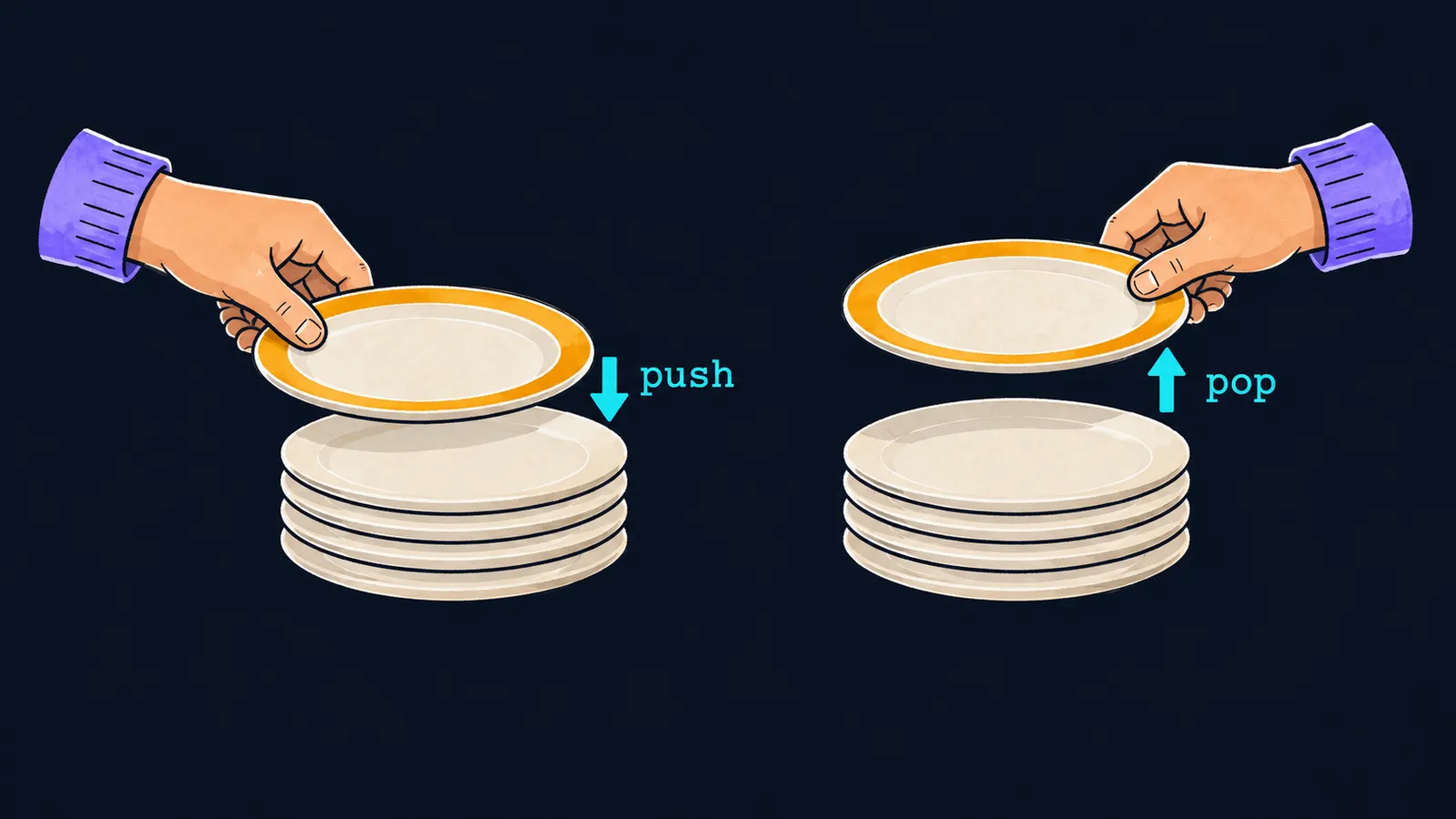
This theme adds no new Go constructs. You will build small tools from parts you already know: slices, loops, map, methods and errors. The first tool is a stack.
Picture a pile of plates. A clean plate goes on top, and you take one from the top too. The plate put down last leaves first.
The Undo button in an editor works the same way: first it undoes the latest action, then the one before it. Here the program needs the reverse of the order in which values were saved.
Undoing actions
In Go, an ordinary slice gives the reverse order if you add and remove elements only at its end:
package main

import "fmt"

func main() {
    var stack []string
    stack = append(stack, "type", "bold", "delete")
    last := stack[len(stack)-1]
    stack = stack[:len(stack)-1]
    fmt.Println(last, stack) // delete [type bold]
}
Let's walk through it line by line:
var stack []stringdeclares an empty pile.appendputs three actions on the pile: typing, bold and deleting.last := stack[len(stack)-1]takes the top action,"delete".stack = stack[:len(stack)-1]removes it from the pile.fmt.Println(last, stack)printsdelete [type bold].
The top of the stack
A stack is a collection of values that you add to and remove from at one end only. That end is called the top. The value put on last is taken off first.
In a slice, the top is its end, that is, the element stack[len(stack)-1].
This is where the plates picture stops working. You cannot pull the bottom plate out of a real pile, but a slice lets you read any element by its index. What makes a slice a stack is an agreement: the code touches only its end.
Stack operations
Three operations work with a stack on a slice.
Push onto the stack
To push a value onto the stack means to add it with a call to append. The call append(stack, "type", "bold", "delete") adds three values in turn, and the last of them, "delete", ends up on top.
Look at the top
Reading stack[len(stack)-1] only looks at the top and does not change the stack.
Pop off the stack
To pop a value takes two steps:
- Read the top:
stack[len(stack)-1]. - Shorten the slice with the expression
stack[:len(stack)-1].
The end index of the expression is excluded, so the slice loses exactly its last element. No elements are copied, so a pop is equally fast on a stack of any size.
Reverse order
The loop for len(stack) > 0 pops values until the stack is empty. They come out in the reverse of the order in which they were pushed:
words := []string{"one", "two", "three"}
var stack []string
for _, w := range words {
    stack = append(stack, w)
}
var out []string
for len(stack) > 0 {
    top := stack[len(stack)-1]
    stack = stack[:len(stack)-1]
    out = append(out, top)
}
fmt.Println(out) // [three two one]
Let's see what happens here:
- The first loop pushes the words onto the stack.
- The second loop pops them one by one and appends them to
out. - The last word pushed was
"three", so it comes out first, and the program prints[three two one].
The element type can be anything: a stack of numbers or runes works the same way.
Where a stack helps
A stack suits tasks where whatever opened last must close first. Two examples:
- nested brackets in an expression—checking brackets with a stack is a common interview task;
- function calls—Go keeps them the same way: the function called last returns first.
Common mistake
A value is popped from an empty stack:
var stack []int
top := stack[len(stack)-1] // ✗
fmt.Println(top)panic: runtime error: index out of range [-1]The length of an empty slice is 0, so the index comes out as -1, and the program stops with a panic. You cannot take a plate from an empty pile. Before you read the top, check that len(stack) > 0, as in the loop above.
Key points
- A stack adds and removes values at one end: the value pushed last is popped first.
- On a slice, push is
append, the top isstack[len(stack)-1], and pop is reading the top plusstack = stack[:len(stack)-1]. - Popped values come out in reverse order.
- Check
len(stack) > 0before reading the top, or an empty stack causes a panic.
Subscribe to take the course
The course is free. Sign in with Telegram and subscribe to the channel to open every lesson.


